#259: SPECTRE
This review was originally published on March 25, 2024.
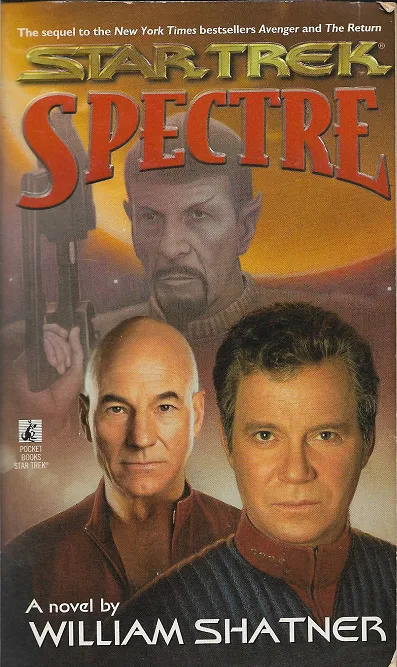
Spectre
Authors: Judith and Garfield Reeves-Stevens, William Shatner
Published: May 1998 (in hardback)
Pages: 372 (in paperback)
Timeline: In the prime universe, concurrent with late season 4/early season 5 of Voyager. It’s at least after “Message in a Bottle” (VOY 4×14), because Picard is aware of Voyager having used the abandoned subspace relay to contact the Alpha Quadrant.
Prerequisites: The book will catch you up on the events of the previous ones pretty quickly. As long as you are aware of the state of the Shatnerverse at the outset, you don’t have to sweat those. What’s really vital to this particular book are “Mirror, Mirror” (TOS 2×04), particularly the ending, which is here cast as the catalyst for all events in the Mirror Universe going forward, and “Crossover” (DS9 2×23).
Jim Kirk is a simple man who wants simple things—to retire in peace on Chal, to ruin his back by refusing to use a phaser to clear out obstinate tree stumps, and to have sex out in the open with his true love Teilani. But Teilani doesn’t believe any of that is the real cure for his spiritual ills, so she sends him into the Great Out-There to find whatever it is that will accomplish that. He’s at a conference for the temporally displaced being a sourpuss around Scotty and Morgan Bateson when he’s kidnapped by a pair of women, a Vulcan named T’Val and … Kathryn Janeway?? Meanwhile, Picard is complaining about the Enterprise-E being wasted on standard nebula duty when maybe the least boring thing possible happens, which is that the long-lost Starship Voyager comes screaming through a wormhole, five years after being yanked to the Delta Quadrant by the Caretaker in the Badlands.
Kate and T’Val bring Kirk to their leader, Spock, but it’s not the regular Spock: it’s the goateed Spock from the mirror universe. They reminisce about their last encounter, when Kirk backed Mirror Spock into the logical corner of realizing that the crumbling of the Terran Empire was inevitable, and that it only takes one person to start a revolution, and Spock could be that person. Kirk never did find out if Mirror Spock ever took him up on those parting words, which I can’t believe I never really thought about, because it would put any story that dared to go there in good company with another stone-cold Trek classic by also exploring the consequences of one of Kirk’s more open-ended solutions.
Anyway, it turns out he did—which made things way worse. Humans and Vulcans are now the slaves of the Klingon-Cardassian Alliance, and folks like Kate and T’Val blame Kirk. Both Kirks, actually: the prime-universe one because he’s the one that talked Mirror Spock into beginning the chain of events that eventually made it happen, and the mirror one because he’s the one who united Klingons and Cardassians and turned them into the unstoppable slavery juggernaut they are today. Evidently, Mirror Spock tried to play the long game by maneuvering Mirror Kirk into the position of emperor of the Terran Empire behind the scenes, then took power and ousted him. What he probably should have done was kill him, because Mirror Kirk escaped, somehow diplomacy’d the two enemies powers together, turned Earth into an unhabitable wasteland, and the rest is (mirror) history.
Over on the TNG end, the Voyager’s crew complement only reads as 32, but Data smells a rat; his scans of their energy use indicate that number might actually be way higher. If it seems like trouble, it’s because it is. Before Picard can walk back the humanitarian effort, the bridge gets handily hijacked by the Alliance. Both soon learn that there are Mirror infiltrators in our universe, and they’re working on one goal: figuring out how to transport the Enterprise-E from our universe to theirs so that the Alliance will truly be unstoppable. Kirk is still mostly on the side of just wanting to go home and wash his hands of all of it, but naturally, that changes when Teilani gets captured. At that point, he’s all in, and manages to rope Prime Spock, McCoy, and Scotty into his shenanigans as well.
There are ten Shatnerverse novels in total, all but one of which loosely comprise three trilogies. Spectre is the beginning of the second such trilogy, and as such, one would hope Shatner and Judith & Garfield Reeves-Stevens would use the opportunity a fresh(ish) start provides to hit the reset button on some of the first trilogy’s worse tendencies. Thankfully, they mostly succeed. Most notably, the rapport between the two generations is much less contentious this time around, with less of Shatner’s ego causing Kirk to talk down to characters who don’t do things his (i.e., the “right”) way. Given that Kirk has been cohabitating with TNG characters for a few books now, Shatner seems to have accepted at this point that they actually are peers of equal talent worthy of equal regard, and even seems more amenable to folding in elements of other series. This is much nicer than the previous “everyone is stupid except me” attitude, and goes a long way toward making this an actually enjoyable novel.
Spectre is at its absolute best when ruminating on the logic of both the mirror universe specifically and parallel universes in general. One incredibly interesting observation it makes is that divergent histories are not always the result of key events themselves being different, but sometimes of differing interpretations of past events, like the ways in which the Vulcans in each universe construe the actions of the early Romulans. It also explores the sensible conclusion that if the histories continue to diverge, then eventually the two universes will no longer share as many or possibly even any identical counterparts, which is stated as an impetus for why the Alliance believes the time to act is now. I love thinking about this kind of stuff, and I appreciate that the book takes some time to stretch its legs and ponder these kinds of really cool logical extremes.
Much of what was annoying about Avenger is handled much better here. Kirk is off of that weird logic kick he was on in that book and now just wants more generally to retire in peace (though he still ludicrously thinks of himself as Sarek’s son). He’s finally making good on the promise of devoting himself fully to Teilani, though it does manifest slightly more as an unhealthy single-track obsession than I think was intended. I was honestly surprised that no characted ever invoked “the needs of the many outweigh the needs of the few” on him. Yet for the first time, this manages to feel not so much like what William Shatner and his ego want, but rather like the product of an actual reflection approaching decent quality on when is the time to stop doing things for everyone else and start doing them for you. Kirk may come across not just as selfish, but also feeling as though he has earned the right to be. There’s a good discussion to be had on the subject of how long one has to live and how much one has to live through to earn the right to be selfish, as well as whether that’s even possible, but this book has some other fish to fry.
Naturally, James T. Kirk always gets to have his cake and eat it too, but the cliffhanger ending at least ensures that he won’t get to rest on his laurels for too long. His mirror counterpart, Tiberius, waits until the very end to reveal himself, after having been built up as a megalomaniac, and it’s clear he’s going to be the primary antagonist of the next Shatnerverse installment, Dark Victory. I’m curious to see how formidable an opponent he is; as I recall, the prime-universe Enterprise crew dealt with him quite easily in the original “Mirror, Mirror”, but perhaps they’ll follow him into the mirror universe, and things would certainly play out differently on his own turf. Who knows? I’m excited to find out, which I can’t believe is a genuine feeling I am having about the Shatnerverse.
MVP & LVP
- I’m giving MVP here to Teilani, because it gives me a chance to talk about another fun thing about Spectre: after three books of mostly staying on the sidelines, she finally gets to have some agency and do some badass stuff. She’s been mostly tender and understanding up to this point, but finally gets to show some grit, and has no trouble keeping up with Picard as they escape their situation together. It’s nothing you wouldn’t expect from a half-Klingon, half-Romulan, but it’s weird that it hasn’t been explored more before now.
- For the second Shatnerverse novel in a row, Geordi gets a raw deal. Beverly and Deanna feature about as little as he does, but at least both of them get a nice moment or two. He’s clearly doing some work behind the scenes, but it’s never described in any detail.
STRAY BITS
- One of the most heartwrenching characters in Spectre is Mirror Neelix, a pathetic, broken man who has been so badly abused by the Alliance that he can barely be approached without flinching and twitching his eye uncontrollably. If you’ve ever been mean to or about Neelix (and there’s hardly a Trek fan who hasn’t at some point), this book will really make you consider taking it all back.
- Another Bolian bridge officer dies in this one, this time off-page. This is really starting to look like anti-Bolian prejudice. I won’t stand for it.
- Data once watched a pot boil — for SCIENCE! Spoiler: it boiled at the same rate as an unwatched pot. (p. 23)
- “Please state the nature of the interrogation requirements” is the most brutal line I’ve read in a Star Trek novel in years. Cold as hell. (p. 68)
- Tan Kral, Nechayev’s aide, is a bald Trill “whose spots [merge] on his bald head.” So not only do they go all the way down, they go all the way up, too! Not quite as much for the imagination to chew on, but there you are. (p. 161)
- I genuinely believed at one point that Picard really was going to murder his mirror counterpart there for a minute. I’ll concede it wouldn’t have been very Star Trek of him to do that, but it would have been pretty metal.
- Mirror Battle of Wolf 359 was the Klingon-Cardassian Alliance’s conquest of Earth and Vulcan, which raises a big question: are there Borg in the Mirror Universe? That question gets answered to some extent at the end of the book. Long story short, there either are or were (unclear), but it seems they’re nowhere near the problem they are in our universe. Spock explains on page 370: “…in the mirror universe … when the Borg were first detected, far earlier than they were in our history … it was almost as if the Terran Empire had been expecting to find them. The Borg did not remain a threat there.” Chilling! I hope this gets addressed sometime in the next two installments of the second Shatnerverse trilogy.
FINAL ASSESSMENT
Good. Each successive Shatnerverse novel, so far, seems to suffer less and less from the weirdness of its namesake’s peccadilloes. Spectre in particular benefits from increased chemistry between the TOS and TNG generations and some really fascinating contemplation on the logical extremes of the Mirror Universe. Honestly, if you were curious enough about the Shatnerverse to consider reading it, you could do a lot worse than to get familiar with the basics of it and start from here. No doubt people are going to blanch at the name on the cover, but these really do better as they go on — up to this point, at least — and this is the best one yet. Recommended.
NEXT TIME: Kirk and Sulu pull the first chairs up to the Captain’s Table with War Dragons