#286: DYSON SPHERE
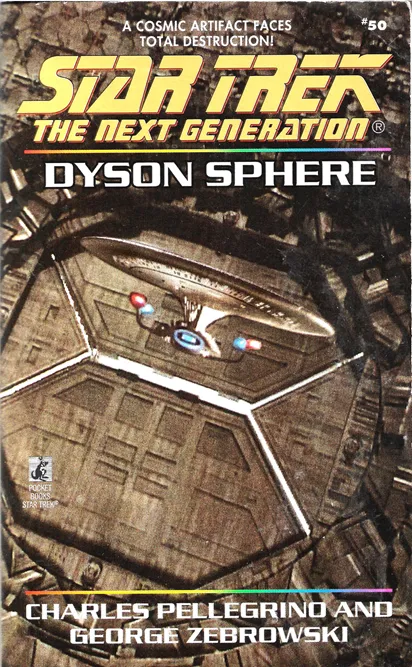
Dyson Sphere — TNG #50
Authors: Charles Pellegrino, George Zebrowski
Pages: 229
Published: March 1999
Timeline: One year after "Relics" (6×04), between "Force of Nature" (7×09) and "Inheritance" (7×10)
Prerequisites: The Dyson sphere explored in this book first appeared in "Relics".
A Dyson sphere isn't a round vacuum cleaner, but it is round and lives in the vacuum (of space). It's a theoretical concept that explores one possible solution to the hypothetical dilemma of a planet not having enough resources to meet its own needs. The idea is, you would build a massive sphere around a star system's sun, and the sphere would absorb the energy of that sun, which it could use to provide energy to the planets within the purview of the sphere basically indefinitely.
In our time, the Dyson sphere is just a thought experiment, but in Star Trek: The Next Generation, it became a reality when they discovered Scotty's tour bus crashed on one in season 6's "Relics". Dyson Sphere is effectively a sequel to that episode, with Picard returning to explore it alongside a team of Hortas led by the sanguine but sometimes cryptic Captain Dalen, and, of course, salivating at the prospect of getting to do an archaeology — though not quite as much as he'd like, as it's discovered that a neutron star (not the one from the previous book, presumably) is on a trajectory to smash into it in thirteen days.
In "Relics", the Dyson sphere was considered abandoned, but here, the Federation learns it's not nearly as abandoned as they initially perceived. There are lots of races living in there, and there is much consternation regarding the regrettable fact that they have only the teensiest speck of time in which to find and catalog the ones they can. But even that short amount of time gets cut off when the Dyson sphere itself detects the neutron star coming and activates emergency systems to remove itself from the star's path, which sets off a series of colossal ecological disasters inside the sphere as planets within it — and the ships exploring those planets — get caught in the torrent of the shifting celestial bodies.
"Colossal" is not even really a big enough word to describe those events. At first, it seemed weird that Dyson Sphere was, by a wide margin, the Bible-quotin'est Star Trek book I'd ever read. Characters are constantly invoking the Good Book, whether they're quoting Psalms, ruminating on the lessons of Job, or making grave comparisons to Revelation. It's very peculiar that a Star Trek novel would cite the Bible more than any given scientific text. That said, it does serve a reasonable purpose, which is that even our most detailed historical accounts of biblical destruction can't compare to the environmental destruction being wrought before the eyes of the crews of the Enterprise and the Darwin.
Where Dyson Sphere starts to falls apart is that these events are so big and of such staggering scale that it's difficult to properly imagine or fathom them as described by mere text. I'm reading words, and I know that unprecedented acts of apocalypse are happening, but they are so supermassive that I feel like I have no true reference point for them, so I feel like I'm imagining them unraveling in ways that are completely wrong, or perhaps facile. And even then, they ultimately barely make a dent in the sphere, which makes you consider just how big that thing has to be, and it's a level of big that I don't think my ape brain can process.
I don't think it's just me sitting around realizing I have no clue what's going on, either. The net result of all this is an episode where the crews of both ships just sort of watch a lot of crazy things happen all around them with no agency in the events that unfold. It's ultimately a lot of slack-jawed gawping and . I guess you can argue there's some excitement, but it's about as impactful in changing the proportion of observing to acting as the Jenolan crashing on the sphere. It doesn't make for terribly exciting reading.
Then, with everybody just standing around staring, one starts to feel like this isn't a story made specifically for Star Trek characters, but instead just happens to feature them. A close analog here is The Joy Machine, which at times felt very much like the author simply shoehorned Kirk into a story that had been sitting in a drawer for a few decades. This one is a little worse off, because in The Joy Machine, James Gunn at least concentrated predominantly on Kirk, but this one tries to be more democratic and feature everybody at least a little bit. The problem, though, is that any time Pellegrino and Zebrowski write a TNG character, it feels like either a season-one characterization or an awkward match to the character who would have most closely aligned with in the non-Trek version. Most of them just don't get anything to do, but Data, for example, suffers quite a bit due to often speaking imprecisely (expressing doubt, rounding numbers, etc.). Also, for some reason, Guinan figures comparatively prominently into this book, but she's presented as an all-knowing empath in a way that feels totally wrong.
Dyson Sphere shares an intriguing number of qualities with the book published immediately before it, the Voyager adventure Death of a Neutron Star. Like that book, it has a scholar of the sciences as its primary author, with a ringer providing continuity support, and it explores a concept that we still don't know a lot about. But these similarities are only superficial, and once again, Dyson Sphere comes out on the losing end.
Cursory research suggests that calling Charles Pellegrino a rigorous scientist may very well be about as accurate as calling Donald Trump a shrewd businessman. Pellegrino's career is riddled with moments of ignominy. One book he wrote, The Last Train from Hiroshima, had to be withdrawn from publication because one of its sources lied about his involvement in the deployment of the two nuclear bombs on Hiroshima and Nagaski, and other people claimed as survivors appeared to be made up. Another, The Jesus Family Tomb, hypothesizes that a tomb in East Jerusalem called the Talpiot Tomb is the burial site of Jesus, his wife, and his kids, and cites sources that are largely apocryphal and sometimes completely forged. He sounds more like he belongs on Ancient Aliens than in Star Trek, and his connection to Star Trek feels of a piece with that of Jackie Marks. The 90s was not a great time for Star Trek attaching itself to reliable names.
George Zebrowski doesn't come out squeaky clean, either, complaining in Voyages of Imagination that "some 20 percent" of the book was slaughtered at the editorial altar without his or Pellegrino's knowledge. Most of the rest of the internet seems to take this accusation at face value, but there's something about the cadence of Zebrowski's words that made me suspect he overstated and/or misrepresented his aggrievement, like when he refers to his novel Strangers Suns as "my Bantam New York Times Notable Book of the Year, Stranger Suns". Like, "how dare someone murder MY darlings!" The one place I got any similarly divergent impression was, of all places, Facebook, from perhaps the one person best equipped to diverge from that impression.
I've been meaning to delete my Facebook account for a while now. I've gotten all the pictures I could ever possibly care about off of there, most of the private groups I used to like are sad hollowed-out husks of their former glory, and the interface is a complete fucking mess. But there are times I'm glad I've dilly-dallied on pulling the trigger, because occasionally, it demonstrates that even now it's capable of coming in clutch when I can dig up a jewel like this while googling around for information about an old, forgotten Star Trek novel:

It seems odd that two supposedly highly learned men would unintentionally misapprehend the function of an editor. Editors do not exist to mercilessly plunge a knife into your beautiful literary baby and hack it to pieces at their whim; they exist, at least in part, to save writers from their own worst impulses. I'm guessing Ordover took one look at the manuscript and thought, This is a bunch of pseudophilosophical rambling where nothing exciting happens. People are going to eviscerate this on the internet when it comes out. I need to fix this however I can. Twenty percent being cut may indeed be about right, as adding that amount back would put the page count right in the 270– to 280-page sweet spot that most Star Trek mass market paperbacks hit. But I can't imagine that 20 percent being so indispensable that its presence would fully restore the book's coherence and quality.
I think there is something to be said for paying homage to the mysteries of the universe. I don't want to call this book's approach wrong or misguided. But I don't think it does anything interesting with that mystery. If they could have saved even one race from the collapsing structure, or had an adventure on one of the planets inside, it could have still spoken to the unfathomable largeness of the sphere on an emotionally resonant level. But this is the kind of story where characters stand around and make mordant bons mots about the futility of human action. And there are times when that can make you feel smaller than anything the infinite vastness of the universe can throw at you.
MVP & LVP
My MVP for this novel is the Horta captain, Dalen. This story is so dull that even the presence of a Horta crew can't drum up a decent amount of excitement, but like most extra-canonical Horta, she has a pleasant mien, evincing a patient outlook that comes from being several orders of magnitude older than the human characters. She also gets a satisfying ending;1 she becomes forever trapped in the sphere when (spoiler) it shrinks down to microscopic size, but is then free to explore it to her Horta heart's content. It's rare to get MVP just on the strength of being likable, but "like" is a feeling that's in short supply when reading Dyson Sphere.
LVP goes to Guinan, who hogs all the moments that would be better off given to Troi and speaks in an odd grandiose manner that somehow manages to feel a little condescending. The El-Aurian vibe is admittedly a hard one to nail, but it doesn't mean turning her in an all-seeing, all-knowing oracle.
CHRONITON PARTICLES
Characters in Dyson Sphere engage in recurring speculation that the Borg have something to do with the sphere, enough to give significant credence to the notion that Pellegrino is more of a philosopher than a scientist at heart. (And of course, like so much else in the story, nothing meaningful ever comes of it.)
"[Picard] reminded himself that he had known the stars too long to be disturbed by dark, empty places; but little banana fingers were curling around his spine anyway." The phrase "banana fingers" nearly made me fall out of my chair. Looking more into it, apparently "finger" and "hand" are farming/industry terms for one banana and a bunch, respectively, but like: bananas don't evoke fear?? We are never financially recovering from this. (10)
Something about the way Data talked made me think This is going to be the kind of book where he drops a contraction, isn't it? And sure enough, on page 37: "I'm seeing traces of thousands." How was this slipping through the cracks in the year of our Lord 1999. The mind reels.
"Picard laughed a little more loudly. Not half bad, he thought. Much better than 'Horta Culture' jokes involving rock gardens." What do you mean, "much better than"? You mean to tell me I could have been having puns of this caliber in my Star Trek the whole time? Look what we could have had. (39)
Captain Dalen believes the Horta originated as self-replicating mining machines that became self-aware and either outlived or abandoned (or killed) their creators. Wild theory (complimentary). (76)
"The Borg appreciated any good thing they encountered. [Picard] had to give them credit for that."
- I don't think "appreciated" is the best word for the job here.
- You do not, under any circumstances, "gotta hand it to the Borg". (80)
FINAL ASSESSMENT
Bad. Unlike the enthusiastic and brisk Death of a Neutron Star, which brought a winsome joy to real cutting-edge science, Dyson Sphere is a slog that trades scientific rigor for high-handed conjecture about theoretical concepts. Its heart is closer to religion than science (derogatory),2 it feels like it was originally made for non-Star Trek characters, and the whole story is based around watching events of unimaginable scale unfold rather than taking an active part in them, and all these problems lead into and feed off of each other. Both authors claim a masterpiece was brutalized by the editorial process, but, to put it kindly, I have my doubts.
NEXT TIME: The Mirror Shatnerverse hopes to celebrate a Dark Victory