#287: DARK VICTORY
Here at Deep Space Spines, we try not to discuss events after a certain point in a given book, but this review does talk about some end-of-book moments that may be construed as spoilers.
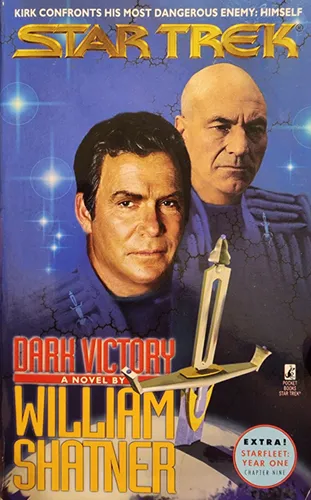
Dark Victory
Authors: Judith and Garfield Reeves-Stevens, William Shatner
Published: April 1999 (in hardback)
Pages: 303 (in paperback)
Timeline: Immediately following the events of Spectre
Prerequisites: References to all Shatnerverse works are regularly dropped.
Picking up immediately where Spectre left off, Kirk passes out while pursuing his mirror universe counterpart Tiberius and wakes up on a ship called the Heisenberg. There, he meets Captain Hu-Lin Radisson, who is part of Project Sign, a super-secret division of Starfleet that was formed right after Kirk's first encounter with the mirror universe and is designed to keep an eye on all incursions to and from said universe. Project Sign has been doing some important work that Kirk's vigilante shenanigans kinda ruined, and Radisson presents him two options: either stay out of the way and never talk about this with anyone again, or rot in a prison colony.
He's able to abide by this for a while, but when Teilani collapses on the day of their wedding, all bets are off. He wants her back, and he ends up practically selling his soul to Tiberius to get her, agreeing to take him to a secret base Tiberius was never able to locate in his own universe in exchange for the antivenom that will cure her. This is a little disappointing, because many aspects of this pursuit cause Kirk to revert back to the egotism that sometimes made the Odyssey trilogy a frustrating and difficult read. But at the same time, I feel a lot of sympathy for him, because if somebody told me I had to sit there and do nothing while my wife's life was on the line, I can't guarantee I wouldn't disobey those orders either. The behavior is annoying, but relatable.
Meanwhile, Dr. Andrea M'Benga (previously of the final novel in the Odyssey trilogy, Avenger) has been shanghaied to Starbase 51, which for some reason is armed to the teeth. M'Benga has come here a few times before, but they suppress her memory of it every time she leaves. She does some research for them, and just as she determines the SHOCKING common ancestor of these children in stasis in a ship just like the one from "Space Seed', they bust out, and she has to be sedated while something called "Operation Wildfire" appears to open phaser cannon fire on them. While working on DS9 later, her memory gets fuzzy during a secret meeting with Kirk and Picard and she passes out, returning to what feels normal to her after she wakes up. But a certain plain, simple tailor is convinced — and hopes to convince her — that there's more going on than meets the (mind's) eye...
Personally, when I watch an episode or read a book about the mirror universe, I'm all-fired to see/read some gut-wrenching twists. Spectre performed capably on that front: an EMH repurposed as an instrument of torture, a grim vision of Neelix as a severely broken and abused man, an eleventh-hour revelation about the lack of threat presented by the Borg over there, etc. It might not have achieved quite the heights attained by the original "Mirror, Mirror" episode or Diane Duane's Dark Mirror, but it delivered. Dark Victory, however, is a fairly sleepy story in this regard, not getting into the real sicko shit until near the end. When it does, it hits like a truck. But that takes a while.
Second installments in trilogies do often succumb to a certain lull, but Dark Victory's hits specific characters hard. After emerging as a pleasantly surprising badass in Spectre, Teilani is back on the bench, put out of commission by her incoming bundle of human/Klingon/Romulan joy, though no less sharp an intellect. Mirror Janeway and T'Val (Mirror Spock's daughter with Mirror Saavik) are even more heavily sidelined. Even Tiberius feels like he's taking a surprisingly long time to make his next move. It's kind of a bummer that Spectre brought out all these really cool characters and then immediately ran out of interesting things for them to do.
Naturally, the only person with interesting things to do is Kirk. As mentioned above, Dark Victory represents a regression from nascent positive trends that had been developing in Shatner's stories. It seemed like he (and by extension, Kirk) had finally learned to be more of a team player, but now he's fully back to only caring about how a situation is going to affect him. I can certainly believe Shatner is fully in control of writing the Kirk parts here. This will probably going to annoy you fairly badly if you have a low tolerance for Shatner's ego, though I admit that doesn't irritate me as much as it does some people. I find him enough of an object of endless fascination to not get rankled by him too much.
I think I like this book less than I originally thought after some reflection, but I'm willing to tolerate some slack from it because I'm confident the next installment can reach some crazy heights using the parts that have been laid out by the end. Sometimes these middle parts just suffer from having to play setup. There's also some extra IRL context I think is going to be fascinating to dig into and see if it adds value or makes it all a big mess. I think the overall slowdown is more of a drag than Shatner going back to Shatning, but I accept all of it to some extent as a price to pay for gearing up for something more exciting. I'm still invested enough to want to see where all of this ends up. It's too bad it didn't maintain the momentum, but it's not a height these books reach often, so it may have been a lot to expect. A finale, however, can accommodate high expectations, so I'm going to have them when we hit Preserver in 2000.
TEN FORWARD TOAST
In the final scene, when Kirk infiltrates Tiberius's base in Mirror Iowa (a riven, bombed-out hellscape, just like everywhere else on Mirror Earth), he sees pictures and trophies of some of Kirk's conquests, which effectively explain why a lot of characters don't have mirror universe counterparts. There's one huge picture of a line of various people being hanged, like Janice Rand, Scotty, Carol Marcus, and even McCoy. But the grimmest pouring-one-out has to go to poor Chekov. After Kirk's perceived leniency with Chekov in the original "Mirror, Mirror" episode, Tiberius makes extra-sure nobody thinks of him as some easygoing bleeding-heart by leaving him in the agony booth on medium setting for 13 days — enough to hurt, but not be completely unbearable. By the time he's finally released into the sweet waiting arms of death, he's a "desiccated body in a transparent tube". Jesus Christ, Ti.
MVP & LVP
- My top pick for Dark Victory is Garak. I enjoy the shine he takes to M'Benga and his insistence on helping her regain her memories, as well as the fact that he stays true to his not-exactly-condonable Garak way in how he delivers on that desire. Always exciting to get some Garak action in a book.
- The LVP is technically everyone in the TNG cast who isn't Picard. Shatner seems to have come to terms with Picard as a peer on equal footing, but has barely gotten around to learning everybody else's names. If I had to pick one in particular, I'd choose Deanna, because why was she even at that secret meeting with M'Benga??
CHRONITON PARTICLES
- Traditional Klingon wedding benediction: "You may now have your way with each other." (p. 142)
- "Scott's story was one that Kirk had almost forgotten, about a brief shore leave they had taken together in the second five-year mission..." — I've always been fuzzy on the concept of a second five-year mission in TOS. At one point I was given to understand the idea had been thoroughly debunked by the demands of other pieces of continuity, but it seems that the aborted Phase II, which got converted into The Motion Picture, was supposed to be that mission. With close to 15 years between the setting of that movie and Wrath of Khan, there could conceivably have been time for a second five-year mission to happen, though nothing's ever been officially set in stone. Overall, I'm not as down on the concept as I used to be, but I'm still a touch skeptical of it. (p. 143)
- According to McCoy, blue jeans haven't been a thing on Earth for 50 years when Kirk wears them at his wedding reception. Hard to believe: jean fabric has been around since the 16th century, was famously the textile of choice for miners' wear in the 1800s, and has enjoyed uncontested dominance as the casual trouser of choice since the 1950s. I have a hard time imagining them disappearing even in the far future, though I suppose stranger things have happened. (p. 146)
- "Kirk wore a traditional Earth shirt, too. The bold graphic on his T-shirt proclaimed the 75TH ANNUAL JAMES T. KIRK MEMORIAL CUP ORBITAL SKYDIVING COMPETITION. A few years back, the organizers had had to drop the word Memorial from the annual contest held on Earth, but McCoy had made a point of sleuthing out one of the old shirts and presenting it to Kirk at last night's rehearsal dinner." — A lot to unpack in only a few sentences: my favorite kind of non-canon lore drop. (ibid.)
- "It was both a wonder and a concern to [Kirk] that the computer-based intelligence programs of this era were becoming so capable of understanding — and discussing — abstract concepts." — Unfortunately, modern life has taken a lot of the former out of the equation. We could have had the Data/EMH timeline, but that feels so far out of reach now. (p. 169)
- Pluto is apparently the best place to store stuff, because even once the sun becomes a red giant, it'll be far enough out of the way to preserve any records that would get scorched out of existence on Earth or Mars. (pp. 194—195)
- Picard, p. 232: "No, Kirk. This is between you and Starfleet. I understand that battle. I've fought them myself when I felt circumstances warranted it. But I've never made that fight a personal vendetta the way you're doing now." This comment just earned Picard a mandatory Clockwork Orange–style rewatch of First Contact.
- If nobody's worn blue jeans in fifty years, who the fuck's gonna have heard of layaway by then, Garak? People today don't know what layaway is! (p. 263)
- "Someday all things would succumb to the dark victory of time, but not today." — You says the title, you wins the prize! (p. 279)
FINAL ASSESSMENT
Average. After the eye-popping insanity of Spectre, Dark Victory doesn't seem to know quite which direction it wants to go, and ends up spinning its wheels for most of the duration. Things gear up again toward the end in a way that suggests this trilogy is going to end with the same bonkers energy it stormed out of the gate with, but otherwise, your appetite for this book is going to depend on how much you like hanging out in this timeline. Thanks to the reliable skill of the Reeves-Stevenses, I do like hanging out in this timeline, but this book is about as low-key as it can get without actually changing my feelings about that. There's definitely an ebb in the energy level here, but I'm still keen to see where it all goes.
NEXT TIME: Battle Lines (VOY #18)